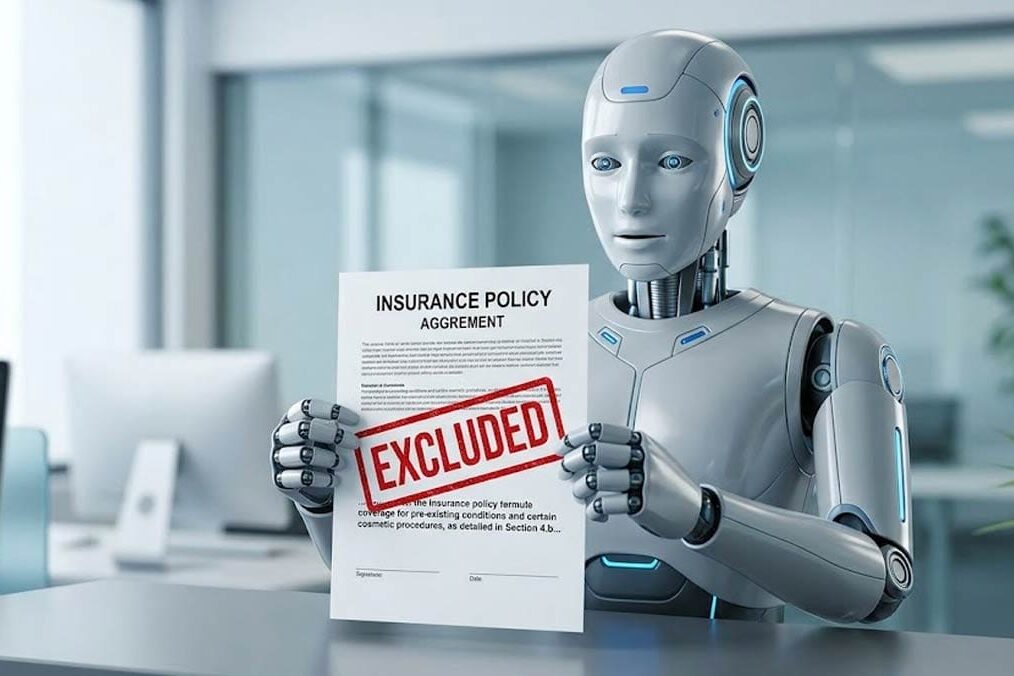
As AI project failures appear increasingly in the press, a less reported consequence is that insurance companies are starting to exclude AI from their policies. The Financial Times reports that large insurance companies including AIG, Great American and WR Berkley are limiting their liability for AI agents and chatbots. In one case, the proposed policy, filed with US regulators, would exclude “any actual or alleged use of AI, including any product or service sold by a company incorporating the technology.”
This follows a series of high-profile AI failures. These range from a court case involving an Air Canada chatbot to a deepfake fraud that cost engineering group ARUP $25 million. Recently there have been major AI project failures at Starbucks and Pizza Hut, the latter resulting in a $100 million lawsuit by a major Pizza Hut franchisee. Insurers are scrambling to avoid liability for the accident-prone technology. A major MIT study found that 95% of AI projects fail to deliver benefit, a result mirrored in a separate study by Boston Consulting Group. In May 2026 a Bain survey on AI projects reported that “The technology worked. The value didn’t arrive”. Insurers are waking up to the possibility that they may end up being liable if something goes badly wrong with an AI project.
There is some precedent here. When ransomware started to appear a couple of decades ago, enterprises initially claimed on their business continuity insurance. Insurance companies quickly reacted to this and started to exclude cybersecurity risks, later creating separate and specific additional insurance policies dedicated to the area. Such policies can have premiums of $1 million or more for large companies.
Although AI insurance as a category is new, it is an emerging area. According to the Geneva Association, in a survey of 600 companies, over 90% of respondents expressed a desire for insurance tailored for generative AI and AI in general. AI introduces new risks such as defective outputs (via hallucinations), biased recommendations, intellectual property infringements, and new cybersecurity concerns.
It is likely that AI insurance will follow the path of cybersecurity insurance. Insurance companies may evaluate risk at specific companies based on factors such as governance, data quality, model monitoring, human oversight mechanisms and testing procedures, and charge accordingly. It is currently tricky for insurers to calculate premiums since the field is so new. Actuaries are deeply familiar with the risks associated with human life. They calculate life insurance premiums based on a host of factors for which there is historic data. These factors range from your age to whether you smoke, drink alcohol, have a risky job (the insurance premiums for a trawlerman are very different from those of a librarian) and many, many more. Even the postal code where you live can have a major impact. In the UK, even within a city, geography matters: residents in Solihull may be expected to live to 88.1 compared to 84.3 years for their near neighbours in Castle Vale, just ten miles away.
This kind of highly specific historical data simply does not exist yet for AI projects. As a consequence, insurers are likely to be conservative, setting broad exclusions and high premiums in order to protect themselves until more data is gathered and the risks are better understood.
The rise of agentic AI is a particular risk. Chatbots can issue faulty advice, as has been seen, and this can cost money and end up in court. AI agents, by definition, have resources at their disposal, and may be able to initiate payments or negotiate contracts. Given that the reliability of AI agents is, at the very least, debatable, enterprises that use them may be incurring considerable risks. Insurers will want to insulate themselves from such risks. This will become even more the case as software vendors start to incorporate agentic AI capabilities within their packaged applications. If you buy an ERP system (say) with an agent embedded within it, and it misbehaves and costs money due to a mistake, who will be liable? The enterprise? The vendor? The insurer?
As with many areas of AI, this is a rapidly evolving area. As the headlong rush to implement AI across industries continues, insurers are (sensibly) evaluating whether they want to be liable for the consequences of an unproven technology, and how to adjust policies and premiums in response. The question is no longer whether AI introduces new risks, but how those risks will be measured and priced.