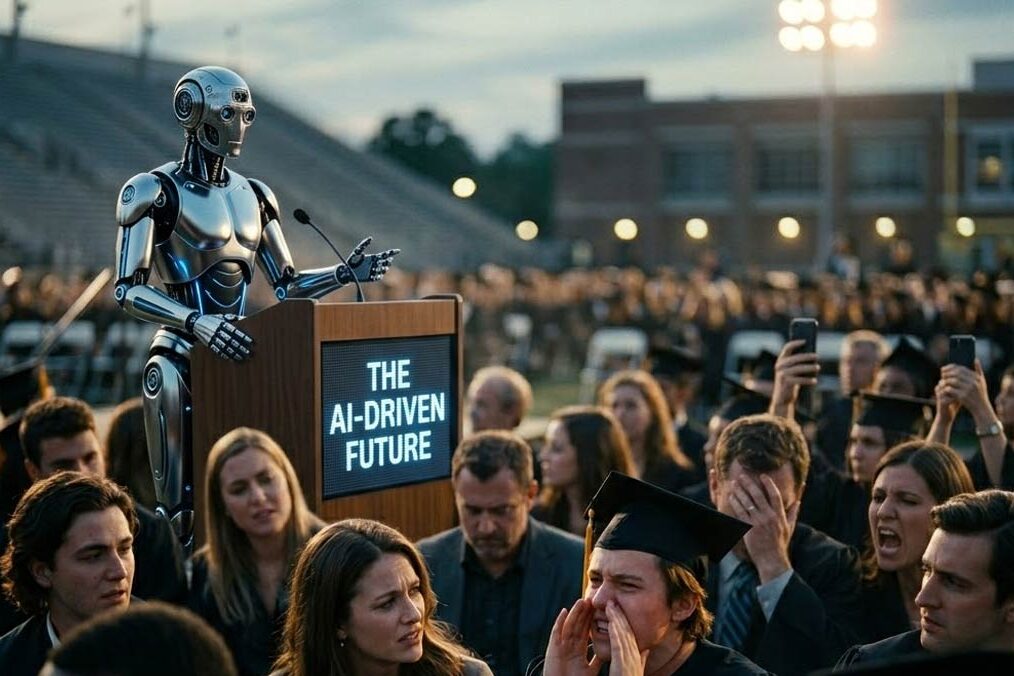
In two separate incidents in May 2026 at US graduation ceremonies, guest speakers were loudly booed by the students when they praised AI. Former Google CEO Eric Schmidt was booed at the University of Arizona’s graduation ceremony, and executive Gloria Caulfield seemed utterly bewildered when she was booed by students after calling AI “the next industrial revolution”.
These are not just isolated incidents. In September 2025 Pew Research Center found that Americans were “much more concerned than excited” about the increased use of AI in daily life. An October 2025 survey by the same organisation across 25 countries found that 34% were “more concerned than excited” compared to 16% “more excited than concerned” about AI. This survey finding showed that AI concern was not just a US-centric issue, though there was substantial variation by country. The US was the most concerned whereas South Koreans were the most positive about AI, though in all but three of the 25 countries, concern outweighed excitement. A survey by Axios of teenagers found that sentiment towards AI has shifted quite sharply negatively from 2025 to March 2026, when the poll was conducted.
It is worth saying that the various surveys suggest that people are a lot more comfortable with some uses of AI than others. They are generally happy about AI being used to detect cancer, for safer transport and for translation, for example. However, they are negative about it having autonomous decision making, are concerned about deepfakes and surveillance, are negative about its use in job hiring, and are anxious about AI being used for manipulating political news.
The attitude of the general public to AI is not helped by statements such as the recent one regarding thousands of layoffs at Standard Chartered Bank. Standard Chartered’s CEO Bill Winters stated at an investor conference that, due to AI driven automation, they were laying off “lower value human capital”. Indeed, it is an industry whose executives frequently make controversial statements about AI replacing whole swathes of jobs. One recent example was Anthropic Dario Amodei saying that AI would wipe out half of white collar jobs within years. Microsoft AI Chief Mustafa Suleyman went further, saying in a May 2026 interview that most tasks involving sitting at a computer will be fully automated within 18 months.
The reality may be quite different to these predictions. The poster child for AI automation is now coding, thanks to recent improvements in AI models, especially Claude, in this regard. Yet in a study by METR, coding tasks using AI actually made developers take 19% longer on the tasks tested. At the very least, the picture is nuanced, since actually typing out program code is only part of what a software engineer does all day. The road for AI chatbots is also proving rocky, as shown by the Klarna U-turn on firing and rapidly rehiring customer service agents after their AI replacement failed with customers. The same thing happened at Commonwealth Bank of Australia. Indeed, a February 2026 survey of 600 HR professionals by workforce development firm Careerminds found that two thirds of AI driven job cuts; over half resulted in rehiring within six months of the layoffs. Forrester reported that 55% of employers that fired staff due to AI now regret it.
If we look at the broader economic picture, the AI productivity miracle, much touted by enthusiastic LinkedIn posts, has yet to appear in actual data. Yale’s March 2026 report showed little or no effect of AI on employment or occupational mix. The study said: “There is no substantial acceleration in the rate of change in the composition of the labor market since the introduction of ChatGPT” and stating “there is nothing meaningful we can either attribute or misattribute to AI”. The National Bureau of Economic Research report in March 2026 found “a productivity paradox, in which perceived productivity gains are larger than measured productivity gains”. The same report stated that “we find little evidence of near-term aggregate employment declines due to AI”. While it is true that productivity effects of technology often take time to feed into government statistics, it is now three and a half years since ChatGPT burst on the scene in November 2022. Analysis by the Financial Times found little or no broad productivity gains due to AI. One in six workers pretend to use AI at work to please their bosses. Over 7 in 10 Americans oppose AI data centers in their area, according to a Gallup poll in May 2026. This reflects widely reported concerns about the effect of AI data centers on electricity supply and water supply, such as the recent diversion of power to Lake Tahoe away from homes towards an AI data center.
There appears to be a substantial disconnect between the level of investment in AI and the productivity impact of it, at least so far. However, the apocalyptic language of AI executives regarding future job destruction certainly appears to be having some impact on public perception of AI. It is scarcely surprising that the public, being repeatedly told that AI will automate most of their jobs, are less than enthusiastic about the technology. Add in the concerns around AI data centers, and there appears to be a substantial AI backlash brewing amongst the public. AI executives have a lot of work to do to prove that their inventions are really delivering a return on investment. That job is being made harder by their tone-deaf pronouncements about job destruction. Until AI vendors and enterprise leaders stop treating workers as “lower-value human capital” and start delivering technology that supports, rather than subverts, the workforce, the booing of AI at university graduations and elsewhere will only grow louder.