Aesop’s fable “The Boy Who Cried Wolf” may have been written 2,600 years ago, but is proving relevant to the AI age. Anthropic CEO Dario Amodei has long had a reputation for issuing dramatic warnings about the risks posed by frontier AI. In 2019, when he was Research Director of OpenAI (before he left to set up Anthropic), he declared that the GPT-2 language model was “too dangerous to release”, citing concerns about the model being abused to produce fake product reviews or fake news. Seven years later, in April 2026 he stated publicly that the latest Anthropic model Mythos was, you guessed it, “too dangerous to release”. In this case, the danger was due to its apparently unprecedented hacking capabilities. This led to the establishment of “Project Glasswing”, where the Mythos 5 model would be released only to cybersecurity researchers, to allow them to address the security vulnerabilities that Mythos identified in mainstream computer systems. The company later produced a version of the same model, called Fable 5, with extra guardrails that would cause it to either refuse to carry out certain tasks (including hacking) or pass the requests to an earlier, less capable, model (Opus 4.8).
Specialists in cybersecurity gave a mixed reaction to the claims, but someone was definitely listening: the US government. On June 12th 2026 an emergency export control was put in place by the US Commerce Department for Mythos 5 and Fable 5. This banned the export of the models abroad, but since this restriction would cover Anthropic’s own staff, including foreign nationals working in the US, it effectively meant that the model was withdrawn from all public access. This was clearly not what Anthropic wanted to happen, so a frantic backpedalling effort was started, with their internal security experts meeting with US government officials. Two weeks later and the lobbying efforts appeared to succeed, with the restrictions lifted on 1st July.
However, this fiasco raises broader questions. Would the US government now restrict other frontier AI models, like OpenAI’s ChatGPT-5.6? Yes, it would seem, with the current situation being a release only to a “small group of trusted partners” at the request of the US government. What does all this mean going forward? Enterprises using US frontier models now have to reckon not only with the usual issues of testing a new model, but the possibility that the US Commerce Department may withdraw access at any time. For example, a multinational deploying a US-hosted model into customer support workflows could find access restricted overnight for non-US staff, forcing an emergency fallback to a lower-capability system. This may be a particular risk given Dario Amodei’s propensity for doom-laden statements about AI – at some point, someone in government may actually take notice of these warnings and take action.
This see-saw of model releases is a boon to Chinese open-weight models, which are only marginally behind the US frontier models in terms of their capabilities. OpenRouter is the world’s largest aggregation platform for large language models. While OpenRouter is not the entire AI market, it provides one of the clearest publicly available indicators of developer preferences because it aggregates hundreds of commercially available models. Its data across 400 AI models shows that Chinese models such as MiniMax, DeepSeek, Qwen, GLM and Kimi overtook the US models in terms of overall token usage in early 2026. This is a huge change, as in early 2025 just five Chinese models scraped into the top 50 models on OpenRouter in terms of usage. The change has been driven by international users, not just increased Chinese usage. By March 2026 the Chinese models had gained 61% global market share, at least as measured by the tokens processed through OpenRouter.
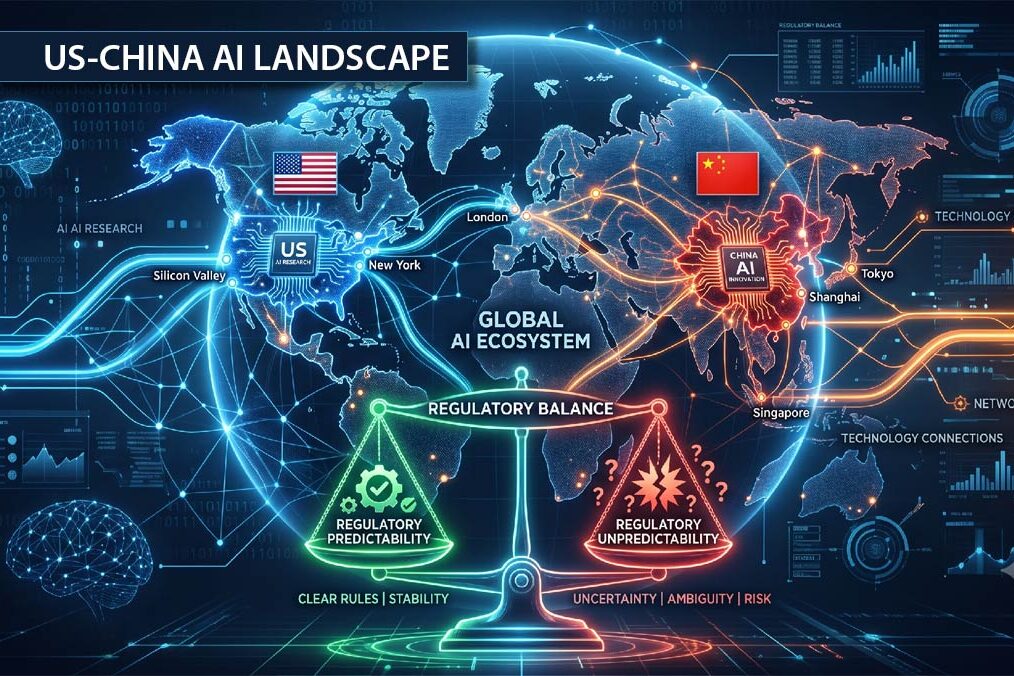
The greater efficiency of the Chinese models means that the economics are in their long-term favour, especially at a time when high AI token costs from US frontier labs are causing well-publicised pricing shocks to enterprises. Now the Mythos/Fable episode with the US government is another reason for international companies to be cautious about relying on US frontier models, which, as can now be seen, be withdrawn (or restored) at short notice by the US Commerce Department. Such unpredictable behaviour is difficult for enterprises to handle.
China has a different approach, with the Cyberspace Administration of China (CAC) requiring all generative AI models to pass rigorous security and ideological audits before they are allowed to debut. This has already resulted in the banning or restriction on models in certain areas, such as the creation of “virtual partners” for minors, and a requirement for human operator intervention in the case of AI chatbots detecting suicidal tendencies in its users.
The more rules-based approach that China has taken to AI regulation, along with the low inference costs and efficiency of its open-weight models, is likely to encourage more enterprises to consider Chinese models. None of this implies that Chinese regulation is lighter or more permissive. Predictability comes at the cost of tighter content constraints and regulatory oversight, which may limit certain use cases, particularly in politically sensitive domains. In many respects it is considerably stricter than the US approach, with extensive pre-release approval requirements and content restrictions. From the perspective of an enterprise customer, though, predictable restrictions may well be easier to manage than uncertainty over whether a model may suddenly become unavailable.
There may be some use cases where only the latest, most powerful model will do, but for the majority of use cases this is simply not the case. The combination of lower costs and greater regulatory predictability suggests that Chinese models will continue to increase their share of the global AI market, at least for now.