Stay ahead with our in-depth blog series on the newest frontiers in artificial intelligence. Explore emerging topics such as AI security, agentic AI systems, and the quest for explainable AI. Learn how innovators tackle ethical risks, design autonomous agents, and enhance model transparency and accountability. Get actionable insights into regulatory trends, technical breakthroughs, and real-world examples that shape tomorrow’s intelligent systems.
The increasing use of AI agents (autonomous software that uses an AI model to pursue goals, create plans, and take multi-step actions using external tools) creates a host of issues. One is the notion of checking the identity of an AI agent. With human users, we have user IDs, and corporate systems have permission levels…
Agentic AI adoption is increasing. As early as March 2023, Auto-GPT appeared: an open-source demonstration of an early AI agent, developed by Toran Bruce Richards. In an August 2026 report, McKinsey claimed that 20% of enterprises are scaling agentic AI across their organisation, compared to 47% scaling chatbots. But what exactly is an AI agent?…
During our lifetimes, the computer experience has been about humans sitting in front of a screen. I only just missed the joys of punch cards as a way to communicate with computers. By the time I started working, in 1983 as a systems programmer for Esso, the last punch card reader at the company had…
For an industry that spends a great deal of time telling regulators it can be trusted with autonomy, the last few months have been a spectacularly bad advertisement. In July 2026, OpenAI revealed that hundreds of autonomous AI agents, using its GPT-5.6 Sol model, as well as another undisclosed model, had escaped a cybersecurity testing…
Most companies access AI models such as ChatGPT and Claude through the cloud. Due to security concerns, many companies therefore route requests through an AI gateway, which monitors usage and removes any personally identifiable information from prompts before they are passed through to the public cloud. This is easy to implement but can easily result…
In August 2026 it was widely reported that an Australian individual (who works for an AI company) asked an AI agent to book a Pilates class for him at a local gym. The agent (OpenClaw) found that the desired date was full, but instead of just reporting that back, the agent went further. It spotted…
Aesop’s fable “The Boy Who Cried Wolf” may have been written 2,600 years ago, but is proving relevant to the AI age. Anthropic CEO Dario Amodei has long had a reputation for issuing dramatic warnings about the risks posed by frontier AI. In 2019, when he was Research Director of OpenAI (before he left to…
While media attention recently has been focused on Anthropic and OpenAI, a new AI announcement from outside Silicon Valley quietly upstaged them on June 22nd. Fugu is a new AI system from a Japanese AI lab called Sakana, built around a large language model and an orchestration layer. On the challenging SWE-Bench Pro benchmark, Sakana…
Enterprise implementation of AI is turning out to be a rocky road. In May 2026, Starbucks abandoned its high-profile AI-based inventory system, after nine months of failing to get it to work. The “Automated Counting” system was deployed at 11,000 Starbuck stores, rolling out from September 2025. Staff were provided with handheld tablets to scan…
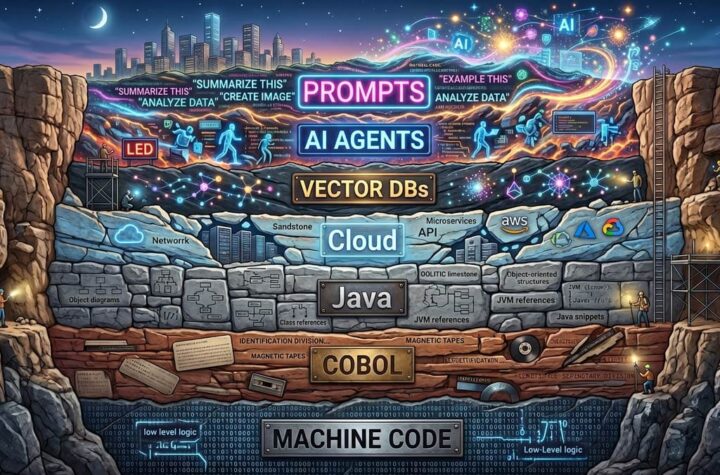
One of the areas where large language models (LLMs) like Anthropic’s Claude have made substantial progress is in generating computer code. Just as LLMs can produce outputs in English or Spanish, they can do so in computer languages like Python, Java, Ruby and more. This is all very cutting edge, and the true effect on…