The restaurant industry generates over $4 trillion to the global economy, and employs at least 50 million people (possibly as many as 100 million). As with any industry, there is potential for the use of AI in various aspects of it, from back-office operations like booking and ordering systems, through to personalised marketing and staff scheduling. There have even been experiments with robots as servers and kitchen staff, though these are very much at the experimental stage.
A June 2025 survey by Deloitte of 375 restaurant executives in 11 countries found that eight out of ten executives planned to increase their investment in AI, hoping for benefits in enhanced customer experience, improved operations, and better loyalty programs in particular. Almost two thirds of respondents claimed to be using AI already on a daily basis for customer experience purposes, and 55% for inventory management. Around two thirds of the companies using AI for customer experience improvement reckoned that it was having a high impact. Restaurants use chatbots to help guests place reservations and order food online, and also to help employees resolve customer service issues. Machine learning is apparently used by 54% of respondents, and natural language processing by 34%. In the same survey, just a fifth of respondents thought that they had the necessary risk management and governance in place, while only a quarter felt that they had the skills needed for effective implementation. The main obstacles have been data management, integration with existing tools and processes, and cultural resistance. The main challenges have been identifying use cases, managing risks, and lack of technical skills.
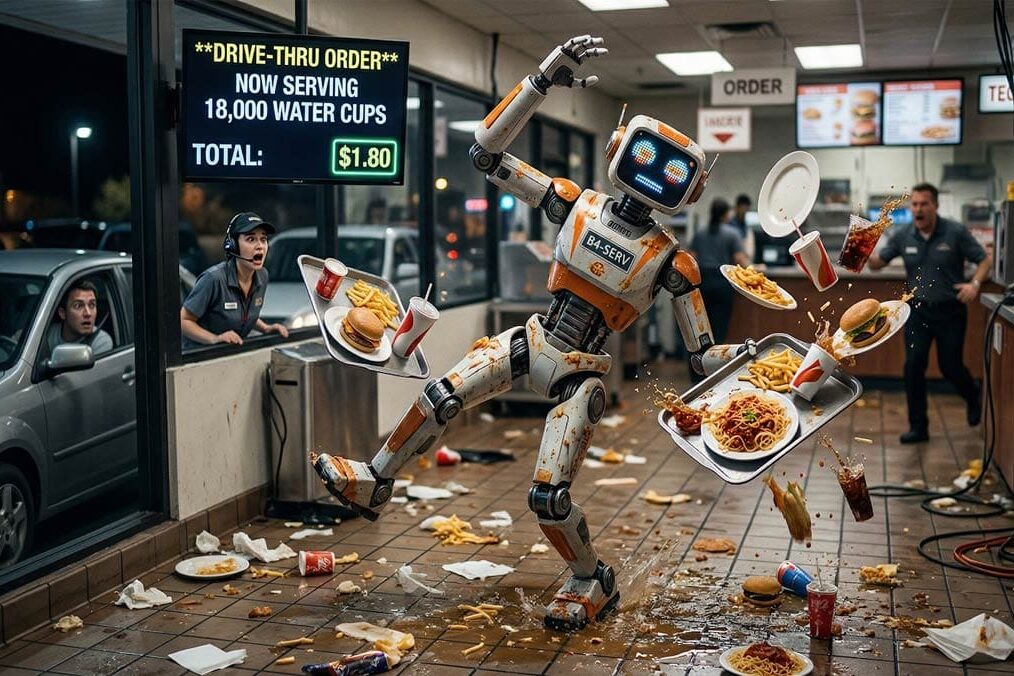
While the above survey paints a fairly rosy and optimistic picture, there has been no shortage of high-profile AI problems in the restaurant sector. In June 2024 McDonalds ended a lengthy trial with IBM for a drive-thru ordering system that resulted in well publicised errors such as adding bacon to an ice cream order, and various erroneous orders such as hundreds of dollars of chicken nuggets mysteriously appearing in a customer order. Taco Bell was reviewing its AI ordering systems in August 2025 after various problems, with the system crashed by an order involving 18,000 water cups, and various repeated misunderstandings of customer orders.
A Missouri restaurant Steffanina’s discovered to their surprise that Google‘s AI search results for their restaurant was offering entirely hallucinated special offers for their restaurant like “a second pizza for $4” or “large pizza for the price of small pizza”. This caused frustration amongst customers, and the restaurant had to post a disclaimer on its Facebook page warning customers not to trust AI special offers. An AI ordering system at White Castle drive-thru tried to charge a customer $15,400 for a $16 breakfast order by adding a hundred chicken ring sliders to the order. Some of these problems are not just embarrassing. In January 2025 the US Securities and Exchange Commission charged restaurant company Presto Automation for making false statements about its AI products Presto Voice, which claimed to automate customer orders but in fact needed an offshore call centre in the Philippines to correct orders in 70% of cases. On the positive side, Starbucks claim that their tablet-based inventory system led to an eightfold increase in inventory checks across a thousand locations.
Robots are being used in restaurants to collect trays, delivering food and even cooking. The robotic restaurant industry is already substantial, with revenues estimated at $2.7 billion in 2025. Sushi making robots alone are a market worth $360 million in 2024, and five thousand robots are in use at US restaurants at the time of writing. Robots offer consistency and precision in food preparation and don’t get tired. However, as a restaurant in California discovered, they can malfunction in amusing ways. Tesla’s Optimus robot was observed to struggle with carrying drinks also. With robots waiters costing less than $20,000 to buy, there is a plausible business case to be made here even in an industry notorious for low wages.
More proven areas for AI include machine learning in inventory management and automated ordering systems. Similar systems can track inventory and purchasing history and spot seasonal patterns, making recommendations for the quantities of ingredients and supplies to order.
Despite the newsworthy mishaps, AI continues its seeming inexorable march into the restaurant world, as it is doing in so many walks of life. The more eye-catching examples like robot waiters are still very much at an early stage, but the use of machine learning in back-office systems like inventory management seems to offer fairly clear business case for a proven technology. Expect to see AI as a permanent menu item in the restaurant industry as time passes, even if it still needs human beings to bring it to the table.