Explore the evolving relationship between artificial intelligence and ethical principles in our comprehensive blog. Learn how responsible AI development impacts privacy, fairness, transparency, and accountability for businesses and society. Discover expert insights on best practices for ethical AI, real-world challenges, and actionable strategies to ensure trustworthy, unbiased, and privacy-safe technology adoption.
Agentic AI adoption is increasing. As early as March 2023, Auto-GPT appeared: an open-source demonstration of an early AI agent, developed by Toran Bruce Richards. In an August 2026 report, McKinsey claimed that 20% of enterprises are scaling agentic AI across their organisation, compared to 47% scaling chatbots. But what exactly is an AI agent?…
In September 2026 the GPT-6 (aka Astra) model was released by OpenAI, followed within days by the latest model in the V4 family from DeepSeek. Both boasted impressive benchmark advances, but the Astra model in particular raised questions about the dangers posed by powerful frontier AI models. Astra was the first OpenAI model rated as…
Anyone who uses the internet will have noticed an increasing number of AI-generated images, videos and text posts on social media. Some are obviously made using AI, but others are harder to spot. Indeed, the use of chatbots by students to produce homework has become a major problem in academic institutions. In July 2026 a…
Did a Munich court just open a legal can of worms for AI companies? Traditionally, internet platforms and search providers like Google have been legally insulated from the content that their platforms display. If they provide a link via a search to a website that had defamatory content or obscenities, they are protected in the…
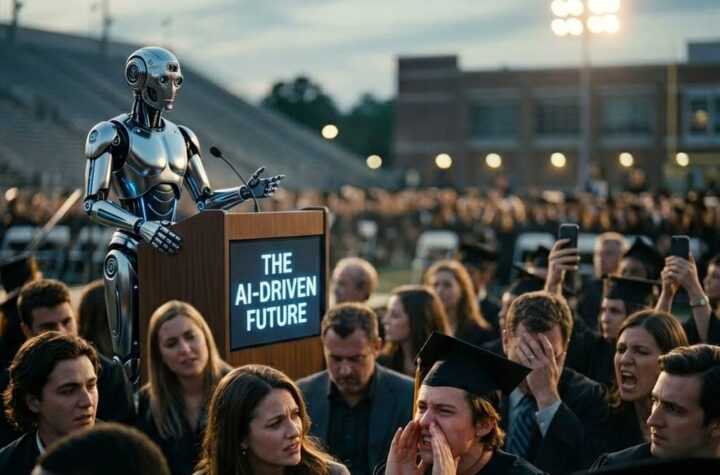
In two separate incidents in May 2026 at US graduation ceremonies, guest speakers were loudly booed by the students when they praised AI. Former Google CEO Eric Schmidt was booed at the University of Arizona’s graduation ceremony, and executive Gloria Caulfield seemed utterly bewildered when she was booed by students after calling AI “the next…
The Black Mirror TV series explored dystopian futures, and one of its recurring themes was the idea of a digital life after death. This was the theme of no less than three episodes: Be Right Back (2013), San Junipero (2016) and Eulogy (2025). As often with science fiction, life is not far behind, and there…
In recent years, there has been much speculation about the possibility of the emergence of artificial general intelligence (AGI). This is an AI that would match or exceed human intelligence in most or all tasks. Such an AI would reason, learn, remember, innovate and adapt to new environments without the need for training or retraining.…
Plagiarism, presenting someone else’s words, ideas, or work as your own without giving proper credit to the source, is not new. The term was coined by the poet Martial in ancient Rome, around 80 AD. However, it has taken on a new lease of life with the widespread use of generative artificial intelligence (AI) based…
It is now almost three years since the release of ChatGPT by OpenAI on an unsuspecting world. In this time large language models (LLMs) have had some significant impacts. Over half of all venture capital investment is now related to artificial intelligence (AI). Nvidia, which makes the graphics processing units that power most AI searches,…
In 2016, AI pioneer and Nobel laureate Geoffrey Hinton argued that there was no point in training radiologists, since it was “obvious” that AI would outperform human radiologists within five years i.e. by 2021. As pointed out in an article in Radiology Business, the number of radiologists employed at the Mayo Clinic actually increased by…