
In case you were in any doubt that ChatGPT and its AI cousins were heavily used by students to do their homework, data shows that the usage of ChatGPT dropped substantially during the 2025 summer break, just as it did the previous two summers. Students are heavy users of generative AI, which will not come as news to teachers and university lecturers. Various surveys have found that the vast majority of students routinely use AI, at a 92% rate in one survey. Yet only 30% of UK schools have an AI policy, a number that drops to 10% globally, according to a UNESCO survey.
Of course, AI can be used positively by students, as well as by the estimated 5% who use it to cheat on their homework. AI tools can help research a subject, check grammar or summarise documents. Educational institutions could do more to educate students about AI, with 72% of students asking for more courses on AI literacy. As well as individual use of chatbots, AI has potential in several areas of education. AI tools can help deliver personalised teaching content that is at a suitable level and pace for an individual student. It can also be used to monitor the progress of students, track their progress and potentially suggest changes to lessons. A 2025 study on the effectiveness of such approaches suggests that they have promise, though they are best used as a supplement to human teachers rather than a replacement for them.
Still, AI tools can potentially help teachers with some of the repetitive tasks in their jobs, helping with tracking attendance, lesson planning and even grading homework. UK government’s advice changed in June 2025 to allow teachers to use AI to mark homework and write routine letters to parents. This does raise the prospect of some students using AI to write their homework assignments, and the teacher using AI to mark it. There is already an entire industry of AI plagiarism tools, valued at $1.2 billion in 2024 and growing at around 10%. This is despite the actual effectiveness of such tools being quite debatable. One study found that several AIs were poor at detecting AI text, and even when they did, some minor editing of the text was enough for detection rates to plummet. The use of AI may also be detrimental to mental development. An MIT study found that those who use LLMs for essay writing have lower brain activity than those who wrote the same essays on their own, confirming the results of another 2025 study done at the London School of Economics.
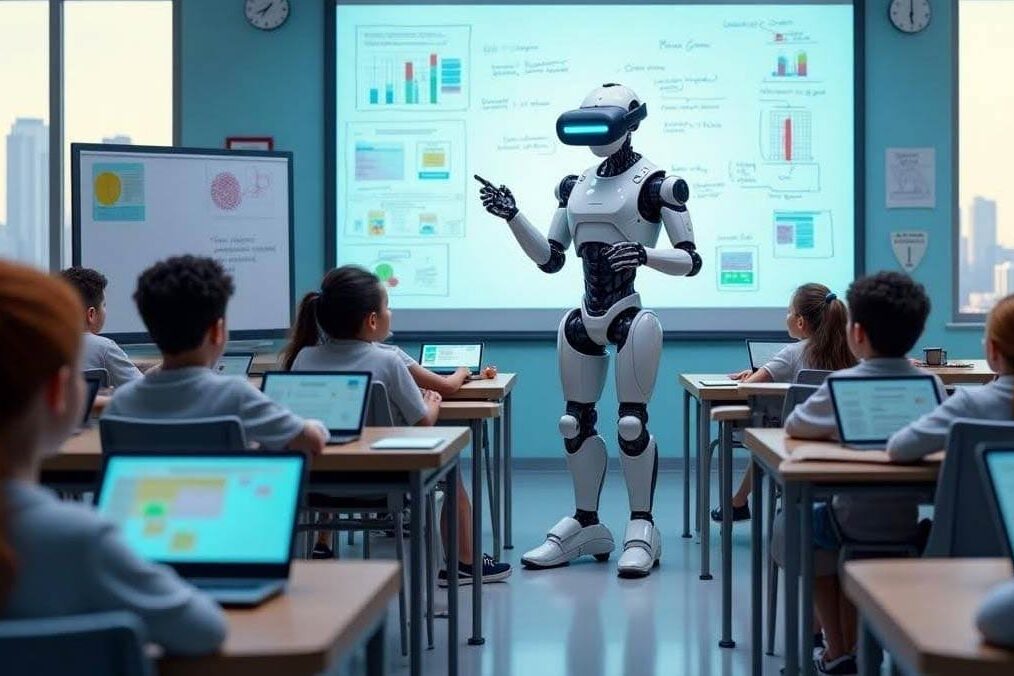
Despite concerns about plagiarism, AI tools can have a positive role. AI teaching tools can be widely accessed day or night, and in remote locations where high-quality teaching may be tough to find. Virtual AI tutors are already in use, and commercial AI tutors are already on sale. The language teaching tool Duolingo has 130 million monthly users, and uses AI extensively, such as its “roleplay” feature for conversational practice. Salman Khan, founder of Khan Academy, a video lesson company, suggests that “By harnessing AI, every student can have access to a personalized tutor in every subject.”
Just as in many fields, AI brings both opportunities and challenges. There is little doubt that teachers will find AI tools useful for helping with repetitive tasks, and the personalised capabilities of AI tools mean that they may be able to provide lessons that are better suited to those who have special needs or need to operate at a different pace than the majority of students. The use of virtual tutors allows people to access education even if they live in environments where access to high-quality schooling is difficult. However, teachers need to be aware of the limitations of AI tools, such as their propensity to hallucinate, and use AI tools where they can genuinely add value. Education establishments need to get better at setting AI policies and educating their faculty and their students about the capabilities and limitations of AI. A world where students use AI to write an essay and the teacher uses AI to mark it is not one in which students and teachers will flourish.


