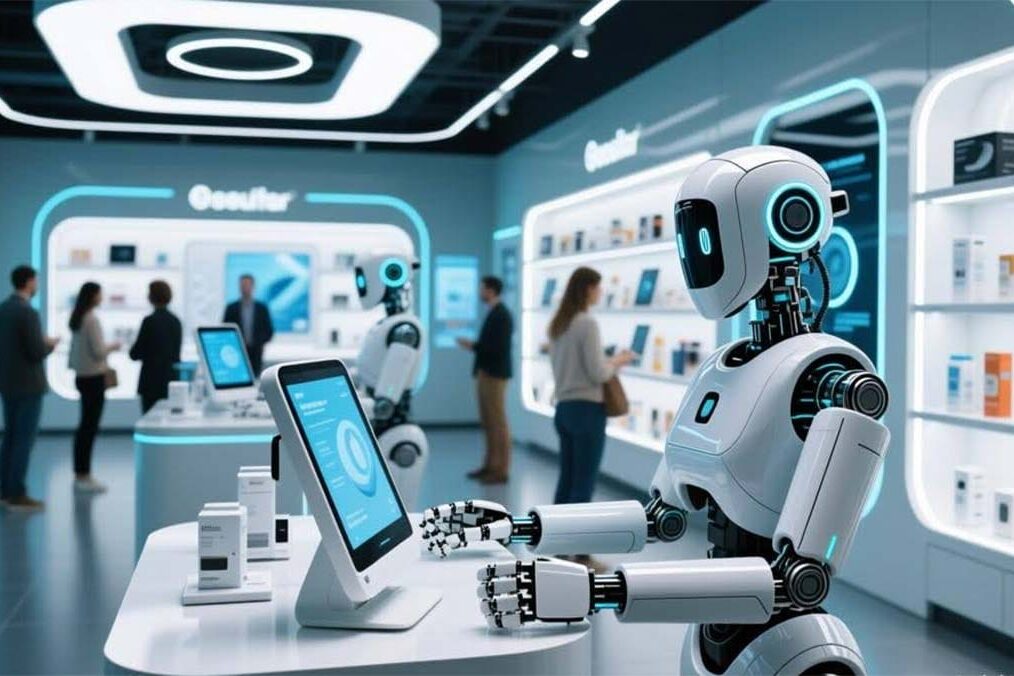
The retail industry has long been a heavy technology user, from the cash register to vending machines to the credit card and the advent of e-commerce. It employs around 500 million people across the world. It is no surprise that artificial intelligence (AI) is making its way into many aspects of retail, from customer service chatbots to demand forecasting to inventory management to price optimisation, personalisation and more. Retail is a highly competitive industry, and every cost saving that can be wrung out of the industries has an impact. Customers have high expectations and are fickle, so retailers have to continuously innovate and respond to changing customer fashions and demands.
AI can be deployed in many retail areas, from back-office systems to retail stores. One key area for a retailer is demand forecasting, predicting what customers are likely to want and when. Demand will vary by season, by specific market and even by the weather. Retailers can analyse historical sales figures, seasonality trends and take into account specific marketing campaigns, promotions and local factors. For example, a summer heatwave will drive up demand for ice cream and air conditioning, while a large concert or festival may increase demand for local hotels and restaurants. Retailers have long employed various techniques to help them here, from regression analysis of historical data, time-series analysis and market surveys. Artificial intelligence can be brought to bear to analyse large datasets, such as data from point of sale terminals, and even to study social media trends to pick up on brand sentiment.
AI algorithms such as machine learning can also be used for pricing optimisation, looking at buyer behaviour, market trends, competitor pricing, demand flows and supply chain costs to help set prices correctly. Dynamic pricing can be used to adjust rapidly to busy periods. Airline tickets are a good example: the price you pay for a ticket on a specific route varies greatly depending on how far ahead you book, the season and the demand for that particular flight. Hotel room pricing responds rapidly to fluctuations in demand, and some sophisticated mathematics can be applied to this problem. The combination of e-commerce and AI can even lead to personalised pricing based on browser history and prior orders as well as general factors. Uber’s “surge pricing” is an example of price responses to local demand, while travel operator Orbitz experimented with showing Mac users higher prices than PC users as far back as 2012, since research had shown that Mac users spent more and were more likely to rent luxury rooms than PC users. One fashion retailer reportedly used AI in 2024 to apply markdown pricing to reduce surplus inventory by 20%. AI is good at spotting patterns in complex data, and there is commercial software available to apply this to assortment planning.
Retailers have been experimenting with generative AI chatbots to supplement or even replace human customer service assistants. This has cost-saving potential and can be successful, though it is not without risk. This area has been the subject of a number of academic studies, and the results appear mixed. Chatbots, for example, result in higher customer satisfaction than human customer service staff when it comes to communicating functional attributes of a product, but less well when describing the experiences of using a product. McKinsey described how an Asian bank achieved over a 20% reduction in customer service incidents and a tripling in self-service channel use by carefully applying the use of an AI chatbot. Yet there have been many well publicised chatbot disasters too. A Chevrolet dealer’s chatbot was manipulated into offering a $69,000 car for $1 (the dealer did not honour the deal). An Air Canada chatbot gave incorrect advice in 2024 on discounts for bereavement, and lost a court case where they tried to blame the advice on the chatbot and evade responsibility. Payment firm Klarna replaced 700 customer service staff with AI but quickly reversed its decision and rehired staff after declining customer satisfaction. A chatbot built by McKinsey using Microsoft Copilot was manipulated by security researchers Zenity into sending the researchers the entire CRM database. This was done without any real “hacking”, just carefully constructed prompts.
A futuristic-sounding use of AI in retail is for visual search and augmented reality. Products like Google’s Vision Match lets customers describe desired clothes and receive AI-generated visual suggestions. Augmented reality allows customers to see how clothing (or makeup) might appear on them. One study in 2024 of 866 customers in India found a positive response from customers of such tools. Simialr functionality is now offered by Chanel, allowing their customers to virtually “try on” their lipstick, nail polish etc. AI can also help retailers and e-commerce sites from fraud. Products like Signfyd are used to help highlight risky orders based on analysis of prior ones. The above uses are in addition to the conventional use of generative AI to produce marketing copy for e-commerce sites.
It can be seen that the retail industry offers a rich set of opportunities for AI, from back-office functions to the stores and their websites. As with all AI, though, it is important to pick the use cases carefully. The cautionary tales mentioned in this article show that chatbots can either go wrong or be manipulated, and present security risks due to issues such as prompt injection attacks. As with any technology, AI techniques need to be carefully planned and tested, with a careful review of security vulnerabilities. Nonetheless, in future it is likely that we will be seeing more and more use of AI in retail, for better or worse.